
Combining time-honored wisdom with forward-thinking innovation.
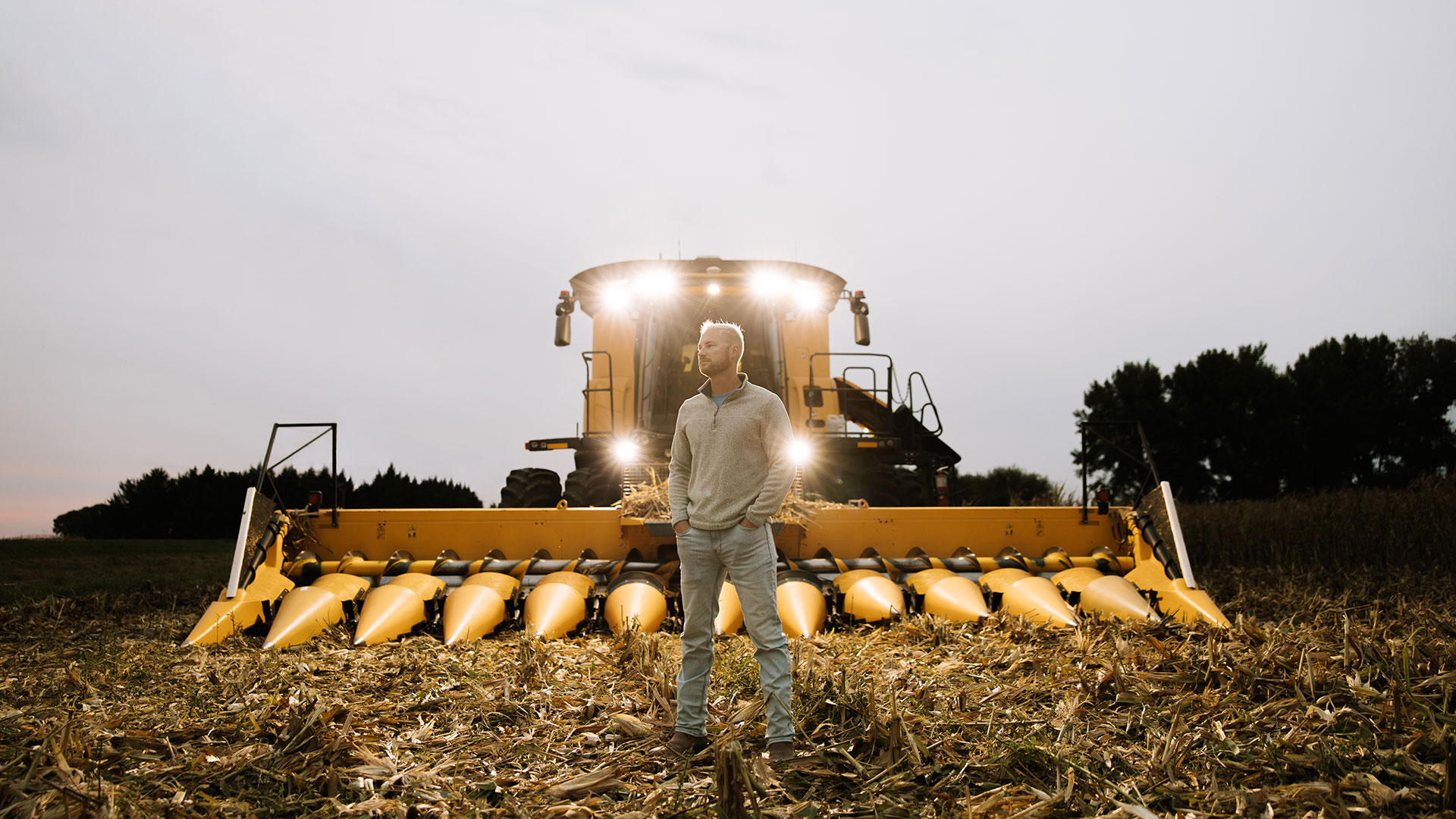
For fifth-generation corn farmer John Krohn, life begins and ends with the soil beneath his boots. It’s where his livelihood takes shape, where his family’s legacy grows and where he strives to improve—one season, one seed, one lesson at a time. “I make my living off the soil,” he says. “And I want to protect that soil. I want to enhance it. I want to do everything I possibly can to make it better.”
His devotion to the soil didn’t come from a business plan or a textbook. It’s a calling and responsibility passed down along with the stretch of farmland his family has farmed for more than 120 years. “I always knew that I wanted to be a farmer,” he says. “My parents inspired me—both of them being farmers. Every free moment I had, I was riding in the tractor or running equipment. I absolutely loved this lifestyle.”
The fact that no two days are ever the same is what keeps Krohn excited. Each morning brings a new challenge, a new chance to learn and another reason to get back in the field. “There’s a lot of variety. In springtime, we’re out there planting,” he says. “Once we get over that initial hurdle, the crop starts to grow, and you’ve got to control the weeds. Then, we start irrigating in the summer and spoon-feeding some fertilizer onto our crop. That’s a totally different mindset than the spring. And when harvest hits, it’s all hands on deck.”
Learning From the Land
While the generational knowledge instilled in him plays a vital role, Krohn is not one to simply rest on tradition. He believes the future of farming lies in balancing what he’s learned from the past with what he’ll discover tomorrow. He views farming as one long experiment—a profession that rewards those willing to innovate, learn and take risks. “Don’t be afraid to fail,” he says. “Take chances—whether it’s switching to no-till or cover crops. Just do it on a small scale. Plan for the best-case and worst-case scenarios. And never be afraid to keep learning.”
That mindset has encouraged Krohn to refine his inputs season after season. Conservation practices like no-till planting, irrigation and cover crops have become central to how he manages his family’s land. The results are clear: healthier soil, less erosion, greater water retention and consistently strong yields. “I want to do everything I possibly can to get every raindrop into the ground,” Krohn explains. “We’re planting into something that’s basically like grass. A couple of big spring rains helps anchor the soil, give us better infiltration and reduce erosion.”
Krohn says those results don’t just show up in his numbers, but also in his sense of pride. “It’s very rewarding to see the management decisions that I made months ago come to fruition,” he says. “It’s good to know the crop’s ready for that big rainfall or able to handle strong winds. Whatever the challenge, I know I’m able to preserve the land and enhance my legacy.”
Building on Generations of Wisdom
For Krohn, every decision or shift he makes for his operation isn’t about change for change’s sake. It’s about stewardship and ensuring that the same ground that sustains his family today will sustain the next generation tomorrow. “Farming is a very competitive business,” he says. “You always need to be willing to innovate. There are always ways to learn and tweak management techniques to make sure you’re doing the best job with the resources you have.”
He’s quick to point out
that his success isn’t a solo effort. During the busiest seasons, farming becomes a full-family operation. “Mom might be running the grain cart, Dad’s in the combine, I’m in a semi and my wife’s in another semi,” he says. “It’s pretty amazing that we’re all able to be productive. It’s a real family effort, and that’s what makes it so fulfilling.”
Even the next generation is starting to get involved. “I was loading the planter with another box of seed,” he recalls. “My daughter came up, and I said, ‘Welcome to my office.’ It’s truly a blessing to spend that time together and let her see how we make a living.”
Looking Ahead
Working the same fields his ancestors once did, Krohn sees more than rows of corn—he sees continuity. To him, every season is part of something bigger: a thread in a story that began more than a century ago. “Some of this land has been in our family for over 120 years,” he says. “In the grand scheme of things—of the soil—that’s just a snapshot. I want to make it better. To improve the soil and build it up.”
He knows that while his time as caretaker is temporary, his influence could last generations. “It fills me with a sense of pride that I’m preserving the resources my parents, grandparents and generations before me worked so hard to build,” Krohn says. “Hopefully, I’m taking it to the next level.”
Related Posts
How generosity and teamwork nourish a small farming community.
For fifth-generation Holdrege farmer Logan Reed, agriculture isn’t just about growing crops, it’s about growing community connections. Connections that were first forged nearly a century and a half ago. “My great-great-grandfather came over from Sweden [...]

Leaving city life behind, a young farmer cultivates community and conservation for generations to come.
Growing up in northwest Omaha, Morgan Wrich watched as the quiet cornfield behind her elementary school gave way to a concrete parking lot and a bustling Lowe’s, a clear sign of the city’s rapid growth. [...]