
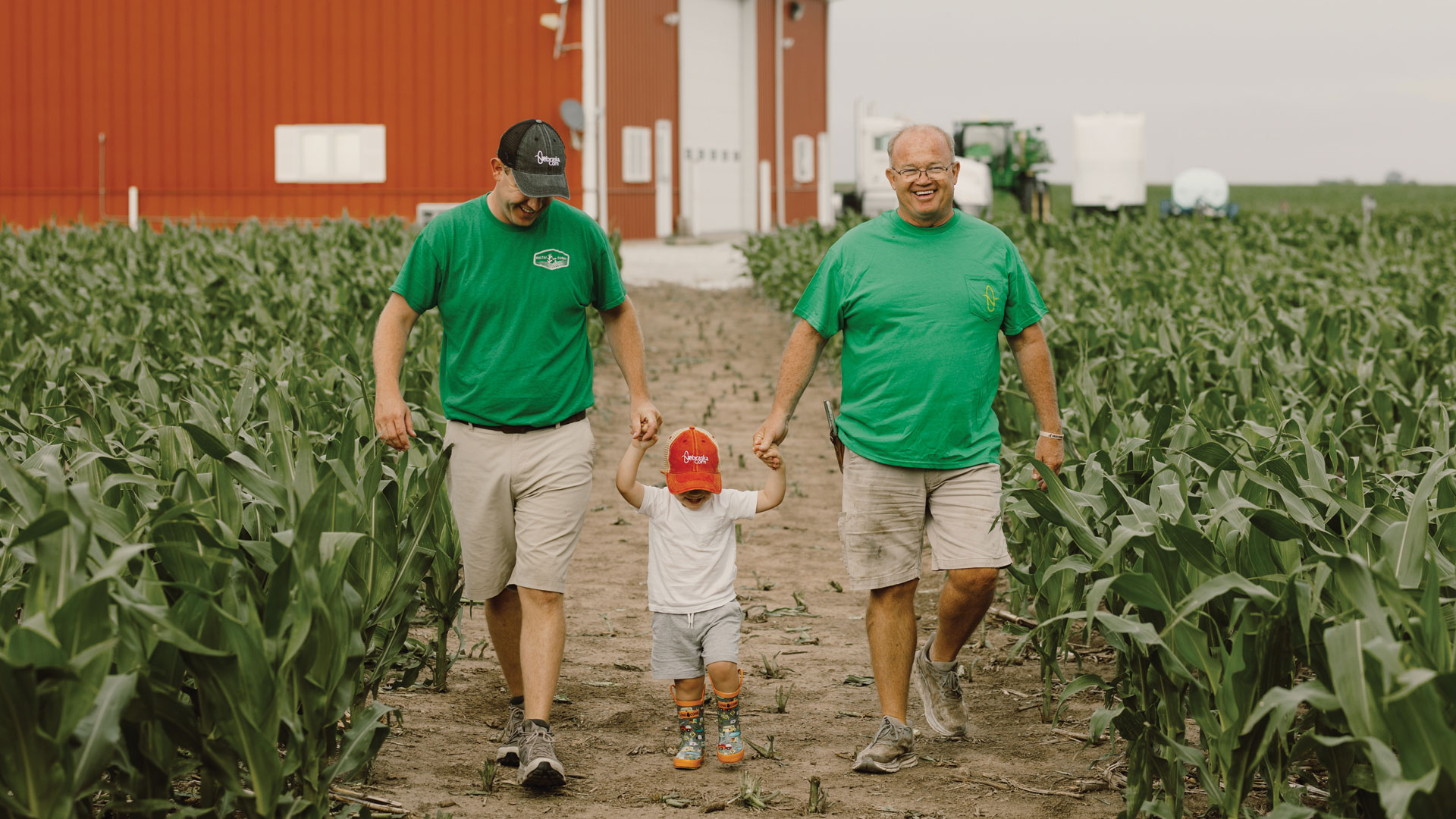
Wood River farmer Michael Dibbern believes that agriculture is about far more than the business of working the land. It’s about connection—to the soil, to the farming community and to the small town he calls home. “Smaller communities are pretty tight-knit,” he says. “People want to get closer with their fellow community members and do fun things. The more they connect, the more likely they are to stick around and stay.”
That sense of connection influences how he spends
his time. From the cornfield to the baseball field, he believes community involvement is
what keeps small-town life vibrant and thriving for generations to come. “I sit on our local village board,” he says. “I want to give my time to making decisions for our community, but also to help out with the youth by coaching some T-ball.”
Seeking Common Ground
While he knows his rural neighbors appreciate how vital his work is to their community’s success, Dibbern wishes the broader public had a clearer view of what farming really demands—the constant decisions, the risks and the relentless drive to do things better. “People know we farm the land, we drive big tractors and we plant a lot of corn and soybeans,” he says. “But I don’t think people always understand the intricacies of agriculture, or that we’re just like any other small business, trying to stay profitable.”
He also points out the dangers of the work. “Unfortunately, everyone knows someone who’s either been in a farming accident or lost their life in one. Whether good or bad, farming bonds us. We look after each other because we all know this is a dangerous job.”
Working Locally, Thinking Globally
Through the years, Dibbern has come to see that farming not only grounds him in his community but also connects him to something far larger—a global network that reaches well beyond his Nebraska fields. Dibbern serves as the president of the Nebraska Corn Growers Association.
“One of the biggest realizations I’ve had since I began farming is just how global this industry is,” he says. “Things that happen on the other side of the planet, whether you see it directly or not, affect what’s going on in your business right here at home.”
He’s seen it firsthand through shifting markets. “A drought in Brazil can send our prices for corn and soybeans higher,” he explains. “Or a huge crop down there—which has been more the norm—can depress our prices here.”
Fast-Paced Progress and Power of Patience
That’s why information has become one of the most valuable tools on his farm when it comes to forecasting, shifting course and staying nimble. “We make decisions not just year to year or month to month, but day to day,” he says. “Having a phone in my pocket or a computer in the office where I can look something up and gain even a little bit of knowledge to make a better decision has helped tremendously.”
That data helps him farm smarter, allowing him to pinpoint specific areas in the field that need attention or require a quick change in course—like adjusting planting populations or fertilizer rates. Still, patience remains one of his greatest tools. “In my youthful years, I was going too fast and not taking the time to fix something as it should be fixed,” he says. “I realized that if you didn’t fix it right the first time, it was going to break again—and cost you that much more time on the back end.”
Linking Family Legacy to Future Generations
Dibbern acknowledges that farming is high pressure and hard work—and not everyone is cut out for it. But knowing that his land has been in his family for generations gives his efforts deeper meaning and motivates him to keep going. “I’m farming some of the original ground that my family farmed together,” he says. “It’s kind of been this full-circle moment—allowing me to farm the same ground my great-grandpa worked in the forties and fifties.”
He adds, “What I want to do for the next generation after me is to have something here for them to take over—to see everything that I did in their own way, make it better and be happy with it.”
In the meantime, Dibbern is motivated by finding his own ways to make the work more efficient and meaningful. “I gain the most satisfaction when I can take a thought or an idea that’s going to make the whole process, or even just a specific task on the farm, easier or more efficient,” he says. “That’s what keeps me going.”
At the end of the day, his goal is simple: to thrive in his work, serve his community and leave something lasting behind. “I want the next generation to see what I’ve done and make it better. To thrive in it—and to be a great person for their community.”
He pauses, then smiles. “I’m a Nebraska corn farmer,” he says. “And there’s nothing else I’d rather be.”
Related Posts
Across much of central Nebraska, farmland adjoins towns, communal waterways and residential areas. Because what happens on the land affects everyone, open communication between producers, neighbors and communities is extremely critical. Nebraska’s Natural Resources [...]
In south-central Nebraska, where Hamilton County’s gravel roads weave between seas of corn, Nate Goertzen carries on a farming legacy with his father and sons on the same land his family has tended to [...]
From the Missouri River to the Wyoming border, Nebraska stretches across hundreds of miles of changing soils, climates and growing conditions. To outsiders, it may look like one continuous agricultural landscape. But farmers know [...]