
“You’re more or less going back to Ground Zero, but now, instead of one negotiation, you have a dozen or more,” said Novak. “History has shown us that these negotiations are not something you can hammer out overnight. It can take three to five years or more—even with a bilateral deal.
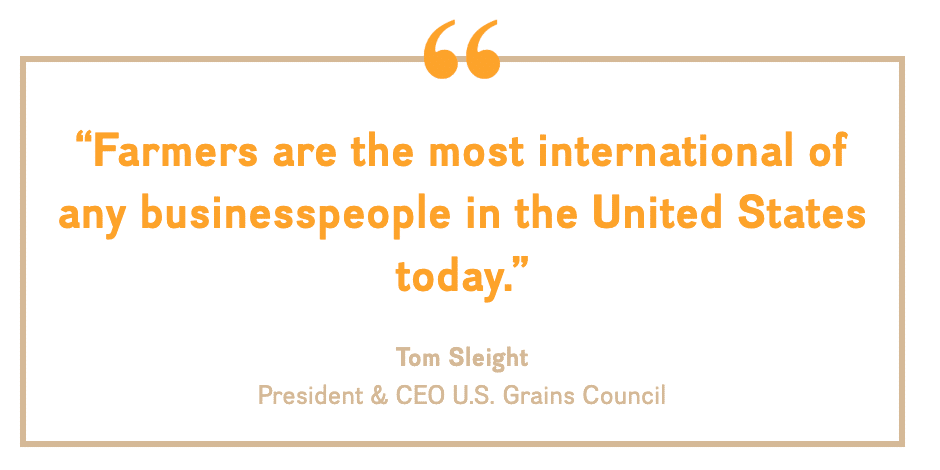
Tom Sleight, president and CEO of the U.S. Grains & BioProducts Council agrees. “You can’t use the words ‘fast’ and ‘trade agreements’ in a sentence at the same time,” he said.


In the meantime, the U.S. stands the risk of losing valuable market share. “Not having trade agreements in place is going to provide an advantage for many of our competitors during a time when we’re fighting for access to every bushel of demand here at home and around the globe,” Novak added.
“If the U.S. is not part of a trade agreement, somebody else will fill that vacuum,” said Sleight. “A great example is the TransPacific Partnership (TPP) that the U.S. recently decided to exit. Obviously, China wants to fill that void with their own version of TPP and capture that rapidly growing market in Southeast Asia and the Pacific Rim.”
Related Posts

From early classroom exposure to national leadership opportunities, the Nebraska Corn Board invests in the future of agriculture by supporting a wide range of educational and leadership programs for young people This guide outlines [...]

Across Nebraska’s gravel roads and morning coffee conversations, a simple statement is evoking a powerful reaction: “I’m a Nebraska Corn Farmer.” Launched by the Nebraska Corn Board (NCB), the campaign invites farmers from across the [...]
When it comes to corn farming, there are many common myths and misconceptions. From farming processes to technology, sit down with a Nebraska farmer to get the facts behind popular corn farming myths! Matt Sullivan [...]